
Metal Powders for SLM Printing
Titanium alloy, commercially pure titanium, and cobalt-chrome — the raw material behind every Space Ti® build, for dental restorations and industrial parts alike.
One powder line, dental or industrial
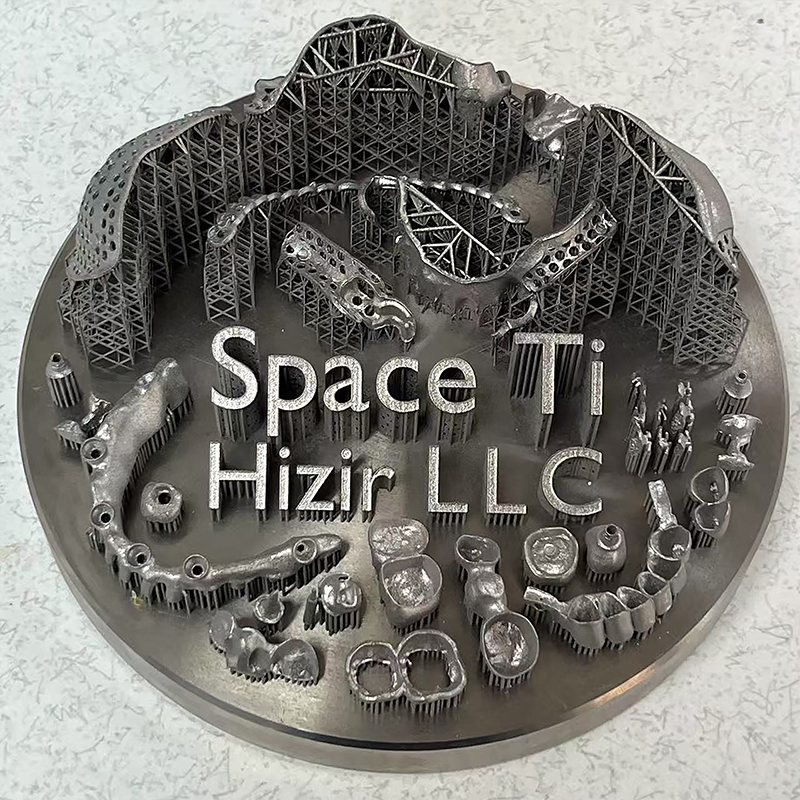
HiZir supplies titanium and cobalt-chrome powders for selective laser melting, made by Audental Metal Technology and shipped with the alloy's IdentAlloy® certificate for every batch. The same powders print dental restorations and industrial parts.
We run them on our own machines, which is why the print parameters are reliable: the powder, the Space Ti-160 printer, and the Space Ti-200 heat treatment furnace are run and supported together — not bolted together from three vendors who never spoke.
New to HiZir? Request a free evaluation sample — tell us your alloy and your printer, and we'll ship enough powder to run a real test build.
Order through Hizirlab
Hizirlab, our dental materials store, supplies the TC4 titanium and both cobalt-chrome grades to dental laboratories, each with its IdentAlloy® certificate — and prints frameworks, crowns and bridges for labs without a printer.
Dental Powders at HizirlabQuote direct from HiZir
For prototypes and production parts outside dentistry, tell us the alloy, the quantity, and the printer you run, and we quote per order. Need finished parts rather than powder? We print those too.
Three alloys, one workflow
Every grade runs on the same printer and the same furnace. Choose by application, not by equipment.
Aerospace-grade titanium alloy — biocompatible, nickel- and beryllium-free, and roughly half the weight of cobalt-chrome. In dental work, the default for implant bars, RPD frameworks, and full-arch cases; elsewhere, for parts that need strength at low weight.
- Ti balance · Al 5.50–6.50% · V 3.50–4.50%
- Density 4.5 g/cm³ — lightest of the three
- Young's modulus 110 ± 10 GPa
- Elongation after fracture > 8%
Unalloyed titanium with the highest ductility in the range — 20% elongation before fracture. Specified where maximum biocompatibility and formability outrank raw strength.
- Titanium > 90%, no aluminium or vanadium
- Density 4.5 g/cm³
- Young's modulus 110 ± 10 GPa
- Elongation after fracture 20 ± 5%
The stiffest option at 200 GPa — in dental work, the familiar choice for rigid RPD frameworks and metal-ceramic crown and bridge work; elsewhere, wherever stiffness counts. Available in two grades tuned for different dental indications.
- Co 62 · Cr 28 · W 8.5
- Density 8.5 g/cm³
- Young's modulus 200 ± 20 GPa
- Elongation after fracture 15 ± 5%
Full material comparison
Standard values are the minimum required by specification. Test values are measured on printed and heat-treated specimens.
| Category | Titanium Alloy TC4 Space Ti® Aerospace Titanium |
Pure Titanium TA1 | Cobalt-Chromium Alloy | |
|---|---|---|---|---|
| Chemical Composition (%) | Titanium (Ti): Balance Aluminium (Al): 5.50–6.50% Vanadium (V): 3.50–4.50% |
Titanium (Ti): > 90 | Cobalt (Co): 62 Chrome (Cr): 28 Tungsten (W): 8.5 |
|
| Processing Equipment | Space Ti-160 SLM Metal 3D Printer |
Space Ti-160 SLM Metal 3D Printer |
Space Ti-160 SLM Metal 3D Printer |
|
| Heat Treatment | Space Ti-200 Rapid Heat Treatment Furnace |
Space Ti-200 Rapid Heat Treatment Furnace |
Space Ti-200 Rapid Heat Treatment Furnace |
|
| 0.2% Offset Yield Strength (MPa) | Standard | ≥ 360 | ||
| Test Value | > 900 | 500 ± 50 | 600 ± 50 | |
| Elongation After Fracture (%) | Standard | ≥ 2 | ||
| Test Value | > 8 | 20 ± 5 | 15 ± 5 | |
| Young's Modulus (GPa) | Standard | — | ||
| Test Value | 110 ± 10 | 110 ± 10 | 200 ± 20 | |
| Metal-Ceramic Bond Strength (MPa) | Standard | > 25 | ||
| Test Value | > 30 | > 30 | > 30 | |
| Density (g/cm³) | 4.5 | 4.5 | 8.5 | |
Test values are measured on SLM-printed specimens after heat treatment in the Space Ti-200 furnace. Full datasheets are available on request — see Downloads.
Two grades, two indications
For dental work, not all cobalt-chrome is interchangeable. Crown and bridge work and removable frameworks pull the alloy in opposite directions.
Cobalt SLM Powder
A molybdenum- and tungsten-bearing Co-Cr for metal-ceramic restorations. Classified as an IdentAlloy® base metal, with the alloy certificate supplied for every batch you receive.
| Composition | Co 61.5% · Cr 28.1% · Mo 5.3% · W 5% · Si 1% · Fe, Mn < 1% each |
| Density | 8.6 g/cm³ |
| Yield strength | 600 MPa |
| Elongation | 8% |
| Hardness | 365 HV10 |
Cobalt H
Formulated for removable partial denture frameworks produced by laser sintering. The higher tungsten and silicon content targets clasp resilience and casting-free flexural behaviour.
| Composition | Co 61.5% · Cr 27.8% · W 8.5% · Si 1.5% · Mn, Fe < 1% each |
| Particle size | 10–60 µm |
| Process | Selective laser melting / sintering |
| Indication | RPD frameworks, clasps, major connectors |
| Certificate | IdentAlloy® supplied per batch |
Titanium or
cobalt-chrome?
The honest answer is that both still have a place. Cobalt-chrome is nearly twice as stiff and remains the reference material for rigid RPD frameworks — technicians have decades of muscle memory with it.
Titanium wins on everything the patient feels. At 4.5 g/cm³ against 8.5, a full-arch framework comes out close to half the weight. Its 110 GPa modulus sits far closer to bone than cobalt-chrome's 200 GPa, so load transfers more naturally around implants. And it contains no nickel, no beryllium, and no cobalt — the three metals behind most reported dental alloy sensitivities.
Where TC4 gives nothing away is strength: at over 900 MPa yield it is over 50% stronger than the cobalt-chrome grade, while still elongating more than 8% before fracture.
Outside dentistry the trade-off is the same one: titanium where weight matters, cobalt-chrome where stiffness does.
4.5 g/cm³ vs 8.5 g/cm³ — the difference a patient notices on a full-arch case.
Nearer to natural bone than cobalt-chrome's 200 GPa, easing stress shielding.
Neither element appears in TC4 or TA1 — a straightforward answer for sensitive patients.
Unfused powder is sieved and returned to the feed — near-zero material waste per build.
Certified batch by batch
Every shipment carries its own paperwork. Nothing leaves without a composition certificate tied to the lot number.
ISO 13485 · CE 0197 · ISO 22074
The marks printed on the powder labels by the manufacturer, listed here exactly as they appear.
Named Manufacturer
Audental Metal Technology makes the powder, and its name is on every label and certificate — so you know exactly whose material is in the drum.
IdentAlloy® Certificate
Each alloy ships with its IdentAlloy® certificate, which records its composition — the disclosure dental work calls for, and a record for any other application.
Where the powder goes
The same four stages regardless of alloy — every stage on equipment we supply and support.
Load & Sieve
Powder is sieved and loaded under inert atmosphere. Ultrasonic sieve and glove box keep the lot clean and the operator safe.
Heat Treat
The Space Ti-200 furnace relieves stress and brings the printed alloy to its final mechanical properties.
Finish
Supports removed, then plasma polishing takes the surface to a mirror finish without hand labour.
Handling it safely, using all of it
Fine reactive metal powder needs to be treated with respect. It also represents real money sitting in the build chamber — over 95% of what you do not fuse can go straight back into the next build if you sieve it properly.
We supply the full handling chain alongside the powder itself, and cover all of it during on-site training.
See Powder Handling Equipment- Ultrasonic sieve & recycler — reclaims unfused powder and removes spatter before it reaches the recoater.
- Powder vacuum cleaner — industrial units rated specifically for combustible metal powder.
- Nitrogen generator — on-site inert gas for both printing and powder transfer.
- Glove box — sealed loading so titanium never meets open air during transfer.
- Sealed storage — powder returns to a sealed, labelled container tied back to its lot certificate.
Common questions
Which powders does HiZir supply?
Three families: Space Ti® TC4 titanium alloy (Ti-6Al-4V), commercially pure titanium TA1, and cobalt-chrome — the latter in a Co-Cr-Mo-W grade for crown and bridge work and a tungsten-bearing Cobalt H grade for removable frameworks.
Are the powders only for dental work?
No. The same titanium and cobalt-chrome powders print dental restorations and industrial parts. Dental labs can order through Hizirlab at hizirlab.com/powders; for any other application, request a quote from us at info@HiZir3D.com.
Which printers are they qualified on?
All three run on the Space Ti-160 and heat treat in the Space Ti-200. The compact Mini-100 takes the same material set at a smaller build volume.
Can I get a free sample first?
Yes. Tell us the alloy and the printer you run and we will ship enough powder for a genuine test build. Email info@HiZir3D.com or call +1 (314) 403-5175.
How is pricing handled?
Powder is quoted per order — alloy, quantity, and delivery schedule all move the number. Submit the materials order form and we will come back with a quote.
Ready to test a batch?
Free evaluation samples for new customers, dental or industrial. Quote-based pricing on production quantities of titanium and cobalt-chrome.